•
In 2013, the Central Government announced the strategic vision of the "Silk Road Economic Belt" and the "21st Century Maritime Silk Road" (hereinafter referred to as the "One Belt and One Road"), and promoted close ties between these two ancient economic corridors in different places. Cooperation. In March 2015, the Central Government further published a blueprint for the program. The goal is to promote trade links, capital financing, infrastructure investment and policy coordination across Asia, Europe and Africa. This includes, in particular, the establishment of a new multilateral development bank, the "Asian Infrastructure Investment Bank" (hereinafter referred to as the "Asian Investment Bank"), focusing on infrastructure financing in the region.
The blueprint also mentions that Hong Kong can play a unique and advantageous role. The Central Government also encourages Hong Kong to participate in the "Belt and Road Initiative" and contribute to it. In the 2015 government budget, the Financial Secretary also stressed that Hong Kong should seize the new opportunities brought about by the "One Belt and One Road."
This "Information Summary" aims to review the latest developments of the "One Belt and One Road" and the potential benefits it may bring to Hong Kong. As for the AIIB and its potential impact, it will be discussed in another "Information Infrastructure" entitled "Asia Infrastructure Investment Bank".
Along the way
The "One Belt and One Road" vision was first put forward by President Xi Jinping during his 2013 visit to Central Asia and Southeast Asia.
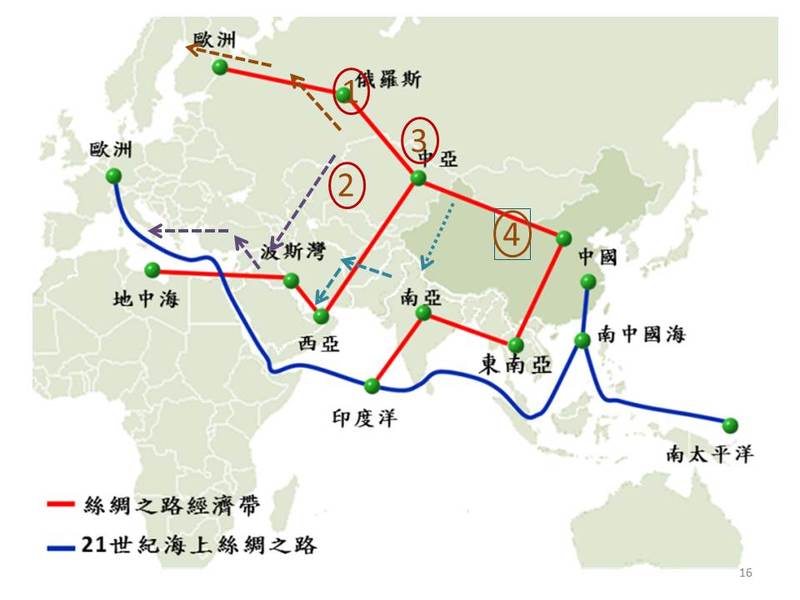
• "One area" refers to the three land routes in the north, including
• (a) Through Central Asia and Russia, connect major routes in China and Europe;
• (b) Bypasses from Central Asia to the Mediterranean via the Persian Gulf; and
• (c) Land routes (Map) from China to Southeast Asia connecting the Indian Ocean.
- The notation symbol stands for concretely speaking, land corridors can not only create new Eurasian continental bridges, but also develop multiple regional routes, including China-Mongolia-Russia, China-Central Asia-West Asia, and China-Indochina Peninsula.
As for “all the way”, the sea route of the Pan-Guide is to cross Europe from the coastal ports of China via the South China Sea, the Indian Ocean, the Persian Gulf, the Suez Canal and the Mediterranean Sea. In addition, this sea passage extends through the South China Sea to the South Pacific.
It is estimated that the two corridors cover more than 60 places and cover 4.4 billion people, which together account for 63% of the global population. The overall economic value of these places is as high as 21 trillion US dollars (162.8 trillion Hong Kong dollars), equivalent to about 29% of global GDP. Moreover, the two corridors running through many developing economic systems in Central Asia, Southeast Asia, the Middle East, and Africa are generally considered as having important economic value and can provide abundant business opportunities.
On March 28, 2015, the central government published a vision and action blueprint for the “One Belt and One Road” initiative to provide more conceptual details. The main features are as follows:
The “Belt and Road Initiative” believes that it can bring significant economic benefits to the Mainland economy. Apart from strengthening bilateral trade along the mainland and two corridors, it can also open up new opportunities for mainland enterprises to “go global”. The brand-new markets on the two corridors can not only absorb some of the excess capacity in the Mainland, but also accelerate the pace of "globalization of the renminbi."
The "Belt and Road Initiative" for various developing Asian economies also helps them accelerate the development of urgently needed infrastructure projects, thus stimulating their economic development. According to the Asian Development Bank study, the average annual demand for infrastructure investment in Asia is approximately US$730 billion (HK$5.66 trillion), but the annual funding of the Asian Development Bank is less than 5% of this amount. Therefore, the "One Belt and One Road" initiative has also received support from local developing regions.
Many advanced economies are also interested in the “Belt and Road Initiative” and believe that it will bring new business opportunities for infrastructure construction and financing. The "Belt and Road Initiative" will also help deepen the economic and trade relations between these advanced economies and some emerging countries in the region. Therefore, the ten largest European economies (ie, Germany, France, Britain, Italy, Russia, Spain, the Netherlands, Turkey, Switzerland, and Sweden) have all applied for the founding of the AIIB before the deadline of March 31, 2015. Member States.